
New-Build Premiums
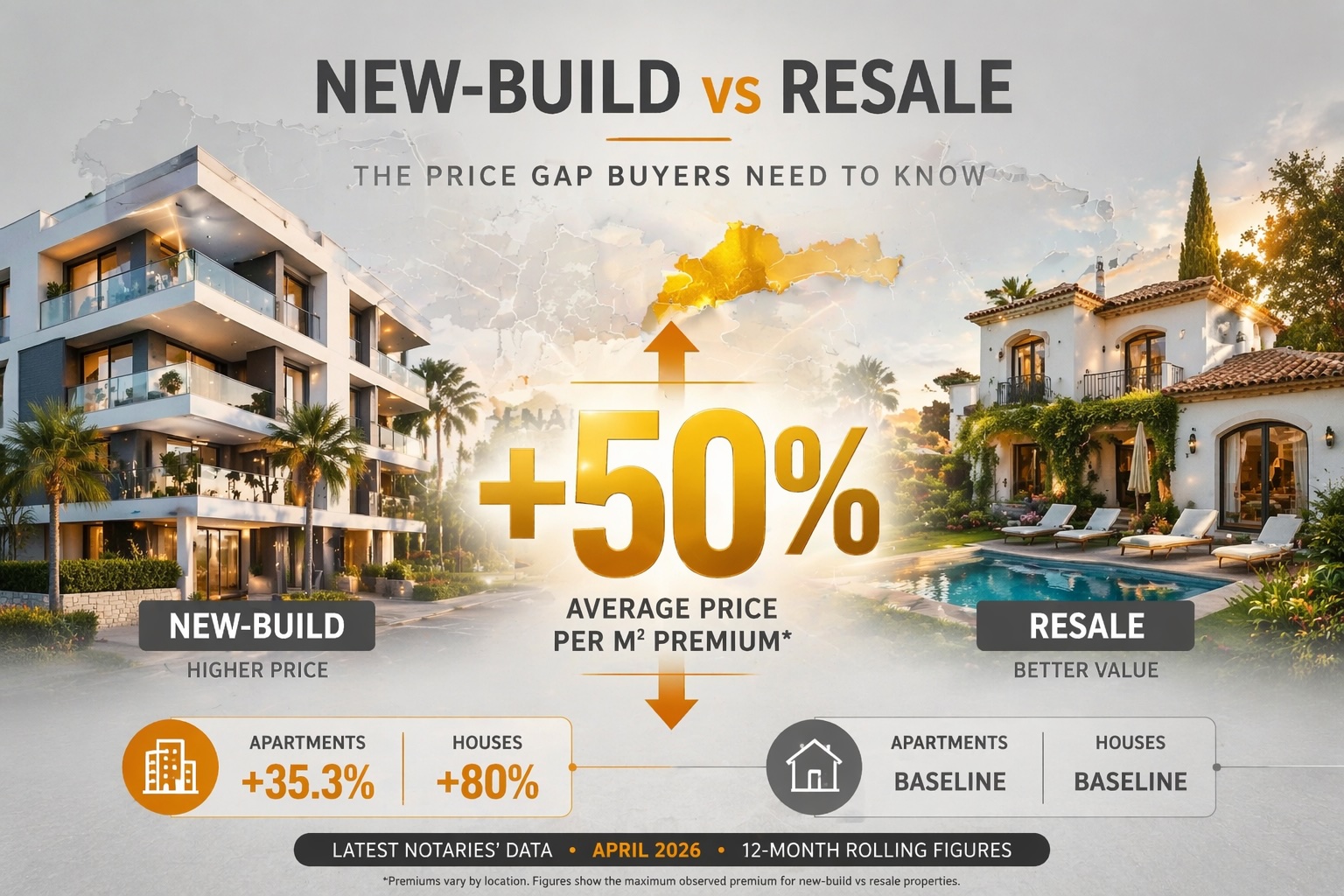
"In normal, balanced markets new-build premiums range between 10%-15% but the latest statistics show new-build premiums in Spain are in another league altogether, an issue property buyers need to be aware of.
There is one issue in Spain’s property market that, until very recently, has been largely invisible. Now it isn’t. For the first time, data from the Notaries allows us to analyse the market in a way that simply wasn’t possible before. Now, with statistics at national, regional, provincial and even municipal levels, we can see prices per square metre separated into new-build and resale categories, and a further split into houses and apartments, revised on a rolling 12-month basis for up-to-date comparisons. This matters because it allows buyers to make decisions based on hard evidence, not marketing campaigns. And the evidence is striking. At its most extreme, buyers considering a new-build house in April 2026 could face premiums of up to 80% compared with resale equivalents, or 35.3% in the case of apartments, depending on location.
Across Spain, there is a chronic and on-going housing shortage and, with no improvement in sight in the short to medium term, we can confidently say that resales will continue to dominate the market. Currently, 92% of transactions nationwide are resales and 8% new-builds and in all locations both new apartments and houses are priced at substantial premiums per square metre compared with similar properties in the resale market. However, in many cases the new-build properties will be inferior in location, quality, and size so the question has to be asked. Why is such a small segment of the market priced so far above the majority sector? In simple terms, the data shows that the smallest segment of the market is often the most expensive — and not always for the reasons buyers assume.
Prime Areas - Supply/Demand Imbalance
The prime areas are labelled as prime not by accident but because they have certain structural characteristics and, in a recent blog, I identified the factors that contribute to the accolade. Around 80% of foreign buyers in Spain head for the coasts and this has been the case since the 1960s. In prime coastal locations, property development has been going on for six decades and it follows that there is very little raw building land available, it was built on years ago. As a result, when new-build opportunities do arise in the best locations, they come into a market of very limited supply, very high demand from both domestic and international buyers, leading, inevitably, to sustained upward pressure on prices.
Even during the excesses of the pre-2008 market, when construction spread aggressively across much of Spain, prime areas behaved differently. When the market collapsed and developments were abandoned across the country, very few of those failures were in truly prime locations. When SAREB, Spain’s bad bank, was established in 2013 to dispose of 1.5 million repossessed properties, the inventory revealed poor, secondary locations, unimaginative architecture, low quality. What the listings did not reveal was a pipeline of prime assets.
Putting a Price on Prime Premiums
In normal, balanced markets new-build premiums are not unusual, ranging between 10%-15% but diminishing, and even disappearing altogether, in locations further away from established centres or smaller unit sizes. However, what the latest data shows are new-build premiums in another league altogether, an issue property buyers in Spain in 2026 need to be aware of.
Prime areas don’t get much more prime that the Costa del Sol’s Golden Triangle, made up of the Marbella, Estepona and Benahavís municipalities so it’s a good case study to use to examine the new-build premiums compared with resale prices. Taking Marbella first, the average new-build premium in April 2026 is 26.8%, falling to 20.1% for houses but rising to 32% in the case of apartments. In Benahavís, home to two of the most luxurious inland urbanisations in Spain - La Zagaleta and El Madroñal - the overall average new-build premium is 68%, slightly lower at 55% for houses and up to 78% for apartments. And lastly, Estepona. Here, the average overall is 22.3%, apartments at a 25.8% premium over resales and houses show a 15% premium. So, in the whole of the Golden Triangle, there is just one category in one municipality, that can be said to be in the ‘normal’ range, everything else is well above. In other words, even in Andalucía’s most established prime market, new-build pricing is operating well outside what would normally be considered a balanced range.
What is less easy to explain are the premiums in what might be called secondary areas where the majority of new-building is concentrated and, therefore, the supply side is under less strain. Staying in Málaga province but outside the Golden Triangle, I looked at the figures for Fuengirola, an area with more raw land available and typically, higher density developments, and found new-build premiums way above those in the Triangle; new-build apartments are priced 50% higher per square metre than resales and new houses are 68% more expensive. If 10%–15% is considered a normal premium, what explains pricing in locations where supply is less constrained yet premiums are significantly higher? And more importantly, will today’s buyers at these prices ever see a return on their investment?
The Psychology of Shiny & New
In the overseas buyer market in particular, demand for new-build property is often driven as much by perception as by fundamentals. It’s a fact that many foreign buyers in Spain do have a preference for a new property and, when supply is plentiful and pricing is either the same or slightly above similar resale properties, I can see why that might be. And I can also understand some of the assumptions behind this preference, for example:
- New means better quality
- New means fewer problems
- New means modern design and technology
- New means the best investment
However, I argue that such assumptions are not necessarily valid and buyers in the current market should keep in mind that new-build properties:
- Are often located where land is available, not necessarily where it is most desirable
- Built to a specification that balances cost and saleability
- Typically smaller in size and in higher density relative to existing properties in prime areas
- Priced at what the market will bear, not the cost of building
That is not to suggest buyers should reject new-build properties outright. But for the first time, the data now allows a more informed question to be asked: is the premium justified in this location, at this time, and for this product? In a market where resales account for more than 90% of transactions, the evidence increasingly points in one direction. Value is more often found in what already exists than in what is newly created.
©Barbara Wood
view our socials
© 2026 The Property Finders, International Property Search & Acquisition Services. All intellectual property in the design, images and text of this website are and will remain the property of The Property Finders. Any infringement of our rights will be pursued vigorously.
GDPR 2018 - We guarantee the personal data entered in the contact form will only be used for the purpose of replying to your enquiry and will not be shared with any other company, service or provider


About the author
Barbara Wood
Barbara founded The Property Finders in 2003. More than two decades of experience and her in-depth knowledge of the Spanish property market help buyers get the knowledge they need to find the right property for them.